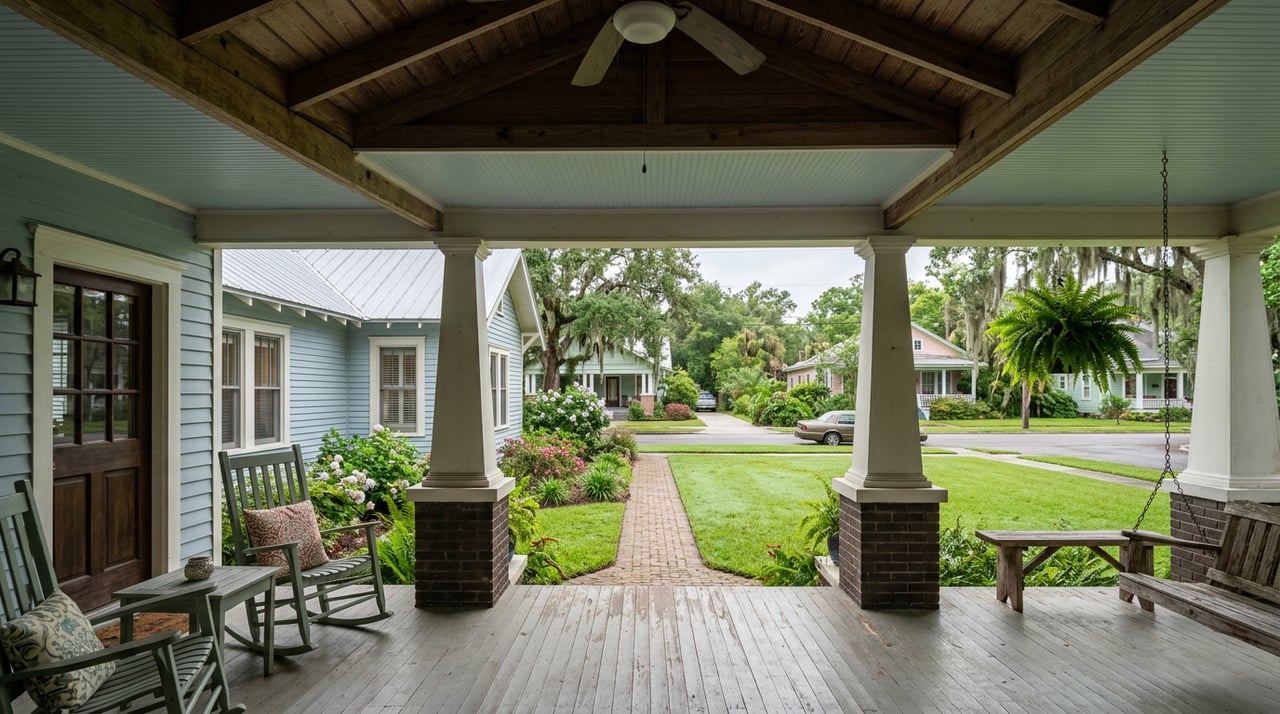
Selling an Older Tarpon Springs Home: Inspections and Historic-District Review
September 10, 2026
Most sellers of an older Tarpon Springs home brace for one kind of bad news: the inspection report that turns up an aging roof, a tired electrical panel, or pipes that make an underwriter nervous. They budget for it. They get a quote from a contractor, plan to have the work done before closing, and move on.
What catches people off guard isn't the cost. It's finding out, sometimes with a buyer's financing clock already running, that the repair itself needs permission before it can start. If the home sits inside Tarpon Springs' local Historic District or the Greektown Traditional Cultural Property District, a new roof or replaced porch isn't just a line item for a contractor. It's a request to the city's Heritage Preservation Board, and that request runs on its own timeline.
Florida's insurance market leans hard on something called a 4-point inspection: a limited review of roof, electrical, plumbing, and HVAC, used by carriers to decide whether they'll write or renew a policy at all. It isn't a full home inspection. It's underwriting.
The age that triggers one varies by carrier. Citizens Property Insurance Corporation requires a 4-point on applications for homes more than 20 years old. Many private carriers set the bar around 30 years, and any home 40 years or older will almost certainly need one before a new carrier will write a policy at all. Florida's insurance market has loosened somewhat heading into 2026, with some carriers pushing their own thresholds back to 25 or 30 rather than the stricter 20-year rule that used to be closer to universal. The practical upshot for a Tarpon Springs seller: don't assume you're in the clear just because a private carrier's threshold sounds generous. Ask what your buyer's specific lender and carrier require before you list.
Here's roughly what trips these inspections up, based on how insurers describe their own underwriting criteria:
| System | What Commonly Gets Flagged |
|---|---|
| Roof | Asphalt shingle roofs over 15-20 years, worn flashing, signs of past leaks |
| Electrical | Single-strand aluminum branch wiring (used 1965-1975), Federal Pacific or Zinsco panels |
| Plumbing | Polybutylene pipe, galvanized supply lines, corroded cast iron |
| HVAC | Systems past 15 years, condensate and drain-line issues |
The electrical row matters more in Tarpon Springs than the roof row does, and that's the part sellers of older homes here tend to underestimate.
Tarpon Springs carries more pre-1970 housing stock than a lot of nearby Pinellas communities. A 2026 housing analysis put roughly 5.5 percent of the city's homes at pre-1939 construction and another 12.3 percent built between 1940 and 1969, concentrated in and around the Historic District, the bayou-front streets near Whitcomb Bayou and Craig Park, and older subdivisions like Kibbee Sub, where recorded build years run from 1906 up through recent infill with a median year of 1973.
That median year sits right inside the window that matters most for insurance: single-strand aluminum branch wiring was standard in homes built between 1965 and 1975. It's not automatically dangerous, but it's a hard underwriting line. According to a Florida insurance agency's April 2026 review of carrier guidelines, no standard Florida insurer will write a policy on a home with active, unmodified single-strand aluminum wiring, and even after a professional repair with COPALUM or AlumiConn connectors, only 6 of 17 major carriers reviewed will accept it. The rest still require a full rewire.
Translate that into a Tarpon Springs listing timeline: if your home was wired in that ten-year window and hasn't been rewired or professionally pigtailed, you may be narrowing your buyer's insurance options before you've had a single showing.
Here's where Tarpon Springs diverges from a generic older-home story. The city's downtown buildings and surrounding historic homes were designated a National Historic District in 1990, and the Heritage Preservation Board has final say over exterior changes to properties inside that mapped boundary, including the Greektown Traditional Cultural Property District.
That authority isn't limited to additions or new construction. Under the city's own rules, certain repair and replacement work, roofing, siding, porch reconstruction, requires a Certificate of Appropriateness before it starts. So the sequence for a Historic District seller often looks like this: buyer's 4-point flags the roof, seller gets a contractor's estimate, and then discovers the roofer can't pull a permit until the Heritage Preservation Board (or, for administratively eligible work, city planning staff) signs off on the materials and design first.
That review adds real time to a transaction that's already running against a mortgage rate lock or an insurance binder deadline. It's the kind of detail that shows up nowhere on a listing sheet and rarely comes up until an inspection report forces the issue.
There's a real precedent for how fast this can matter. As Suncoast News reported, after Hurricanes Helene and Milton hit in 2024, the city's Principal Planner told the Heritage Preservation Board that the Fruit Bowl neighborhood, inside the local historic district, experienced what she called "devastating flooding impacts from Hurricane Helene." City planning staff asked the board to let them handle certain storm-related repairs, porch replacement, roof work, siding repairs, administratively rather than sending every homeowner through a full board hearing.
The board agreed, but the city attorney was specific about the limits: that streamlined review only applies during a declared state of emergency, not as a permanent shortcut. Staff had actually asked for up to three years of administrative flexibility and were told the exemption legally can't outlast the emergency declaration itself.
That distinction matters for anyone selling a Historic District home today. The emergency-era shortcut that got some neighbors through 2024 storm repairs faster doesn't apply to routine listing-prep work now. Outside of a declared state of emergency, exterior repairs in the district go through the standard Certificate of Appropriateness process, on the board's normal schedule, not an expedited one.
If you're preparing to list an older home in Tarpon Springs, or you're a buyer who's fallen for a bungalow near Spring Bayou, the fix isn't complicated. It's sequencing.
None of this needs to derail a sale. It needs to happen in the right order, which is the whole point.
What should owners of older homes consider? An older home still faces the same insurance-driven 4-point issues.
Can I just sell the home as-is and let the buyer deal with the repairs? You can, but it narrows your buyer pool to cash buyers or those whose lender and carrier don't require the repair upfront, and it usually shows up as a lower offer or a larger repair credit at the table.
How long does a Certificate of Appropriateness review actually take? It depends on whether the work qualifies for administrative approval or needs a full Heritage Preservation Board hearing, which runs on its own meeting schedule rather than a same-week turnaround. Confirming this with city planning staff before you commit to a repair timeline is worth the phone call.
If you're weighing whether to list an older home in Tarpon Springs, or you're comparing what a historic bungalow near downtown actually costs to prepare for sale versus a newer build a few streets over, Brenda Endres can walk through your specific address, your home's build era, and what a realistic repair-and-review timeline looks like before you put a sign in the yard. Let's Connect.
This article is general information, not legal, tax or financial advice. Consult a qualified professional about your situation.
Stay up to date on the latest real estate trends.
If your home came off the market without selling, review the pricing, buyer feedback, presentation, and property details before relisting. Here is where to start.
With over a decade of experience in real estate, mortgage lending, and title services, I bring a well-rounded perspective to every transaction. My goal is to make buying or selling a home feel straightforward, informed, and tailored to your needs while building lasting relationships beyond closing day.